
Your Family Deserves the Best Care Book an Appointment
Your skin health matters, so don’t delay. Our clinicians look forward to treating you and your family at one of our local New England practices.
Find Your Nearest APDerm Center
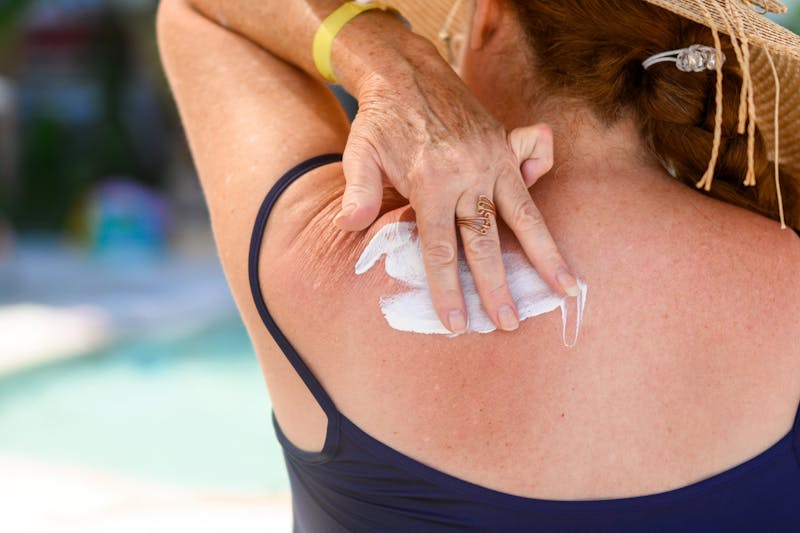
Stronger than most people assume. UV intensity peaks between 10am and 4pm from late spring through summer, and New England's long daylight hours mean more total exposure time, even on cooler days. A cool ocean breeze can make 85 degrees feel comfortable, but it does nothing to reduce UV exposure. People get some of their worst sunburns on days that don't feel that hot.
Yes. Up to 80% of UV radiation passes through cloud cover. A hazy day at the beach or an overcast afternoon on the boat can still deliver significant UV exposure, and it's one of the most common ways people end up sunburned in July without expecting it.
Broad-spectrum SPF 30 or higher, and ideally SPF 50 for extended time on water or sand, since both reflect UV rays back onto the skin and increase total exposure. Water reflection alone can boost UV exposure by up to 25%. Choose a water-resistant formula if you're swimming or sweating, but plan to reapply regardless.
Most people use less than half of what they need. The standard guideline is about one ounce, roughly a shot glass full, to cover the body for a swimsuit-level area of exposure, and about a nickel-sized amount for the face. For a full beach day, that often means going through more sunscreen than people expect, especially with reapplication.
Every two hours in direct sun, and immediately after swimming, sweating, or toweling off, even with a water-resistant formula. Water resistance typically lasts 40 to 80 minutes depending on the product, not the whole day. If you're at the beach from 11am to 4pm, that's realistically three or four applications.
Mineral sunscreens with zinc oxide or titanium dioxide are generally the better choice for kids, since they sit on top of the skin and tend to be better tolerated by sensitive skin. Look for water-resistant, broad-spectrum formulas, and reapply more frequently than you think you need to, since kids in and out of water rub most of it off quickly.
The jump in protection above SPF 50 is small, SPF 30 blocks about 97% of UVB rays and SPF 50 blocks about 98%. The bigger factor is application amount and reapplication frequency. A consistently reapplied SPF 30 will protect you better than an SPF 100 applied once in the morning.
Yes to both. A wet white t-shirt offers minimal UV protection, sometimes as low as SPF 3 to 5. Umbrellas and shade help, but UV rays scatter and reflect off sand, water, and pavement, so you're still getting exposure even when you're not in direct sun. Sunscreen is still necessary under both.
Often, yes, especially for people who sweat heavily, swim regularly, or have sensitive or post-procedure skin. Medical-grade formulas tend to have higher concentrations of active ingredients and more reliable SPF delivery than many drugstore options.
We carry EltaMD in-office and through APDerm Shop, since it's a brand we trust for both daily wear and higher-demand summer use. EltaMD's UV Sport and UV Physical formulas in particular hold up well to sweat and water without feeling heavy, which is often the deciding factor in whether someone reapplies during a full day outside. You can browse our full sunscreen lineup here if you're not sure which formula fits your skin. If you've struggled to find sunscreen that doesn't irritate your skin or wash off easily during summer activity, it's also worth talking to your dermatologist about which option fits your routine best.
Use the ABCDE rule: Asymmetry, irregular Borders, multiple Colors, a Diameter larger than a pencil eraser, or a spot that's Evolving in size, shape, or color. Late summer and early fall, after peak sun exposure, is a smart time to schedule a skin check, since new or changing spots are often easier to notice once tan lines fade, and you've had a chance to really look.
If you have questions about sunscreen for your skin type or it's time for your skin check, our team is here to help. Schedule an appointment at an APDerm location near you, or shop EltaMD sunscreens directly through APDerm Shop.
Your skin health matters, so don’t delay. Our clinicians look forward to treating you and your family at one of our local New England practices.
Find Your Nearest APDerm Center