
Your Family Deserves the Best Care Book an Appointment
Your skin health matters, so don’t delay. Our clinicians look forward to treating you and your family at one of our local New England practices.
Find Your Nearest APDerm Center
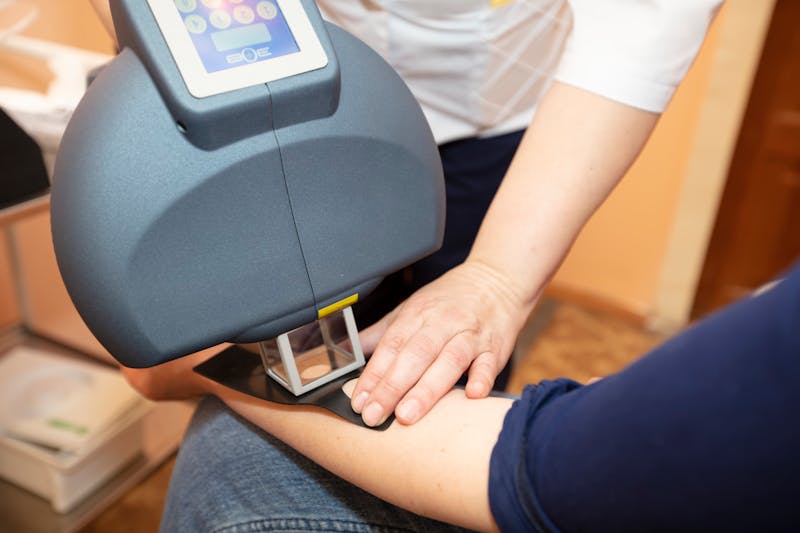
For patients whose psoriasis doesn't respond well enough to topical treatment, or who have plaques covering larger areas of the body, phototherapy is often the next step before considering systemic medication. It's one of the oldest treatments for psoriasis, but the technology and precision behind it have improved significantly.
Phototherapy uses controlled exposure to ultraviolet light to slow the rapid turnover of skin cells that causes psoriasis plaques. It's administered in a medical setting under a dermatologist's supervision, which is different from tanning beds or unsupervised sun exposure, neither of which deliver the specific wavelengths needed for therapeutic benefit or the safety monitoring required.
Narrowband UVB is the most common form used for psoriasis. It targets a specific range of UV light shown to be effective for plaque psoriasis while minimizing exposure to wavelengths that don't contribute to treatment.
Excimer laser delivers a more concentrated, targeted dose of UVB light and is typically used for smaller, stubborn plaques that haven't responded to other treatments, such as on the elbows, knees, or scalp.
APDerm sessions are quick, usually just a few minutes, but they require consistency. Most patients come in two to three times a week for several weeks before seeing meaningful improvement. Treatment is gradually adjusted based on how your skin responds, starting with a lower dose and increasing over time.
Many patients find the routine itself manageable once it's built into their schedule, and appreciate that it avoids the systemic side effects that can come with oral medications.
Phototherapy tends to work well for patients who:
It's not typically the first choice for patients with very limited, mild plaques, where topical treatment is usually sufficient, or for those who can't commit to the frequency needed for results.
The most common side effect is mild redness similar to a sunburn, which your dermatologist will monitor and adjust for. Long-term treatment requires periodic skin checks, since cumulative UV exposure over years is a factor your provider will track, the same way they would with any UV-based therapy.
Most patients notice improvement within four to six weeks of consistent treatment, though full clearing can take longer depending on severity. Phototherapy is often used as a way to get skin under control before transitioning to a lower-maintenance topical regimen.
Ask your APDerm dermatologist if phototherapy is a good fit for your psoriasis treatment plan.

Your skin health matters, so don’t delay. Our clinicians look forward to treating you and your family at one of our local New England practices.
Find Your Nearest APDerm Center