
Your Family Deserves the Best Care Book an Appointment
Your skin health matters, so don’t delay. Our clinicians look forward to treating you and your family at one of our local New England practices.
Find Your Nearest APDerm Center
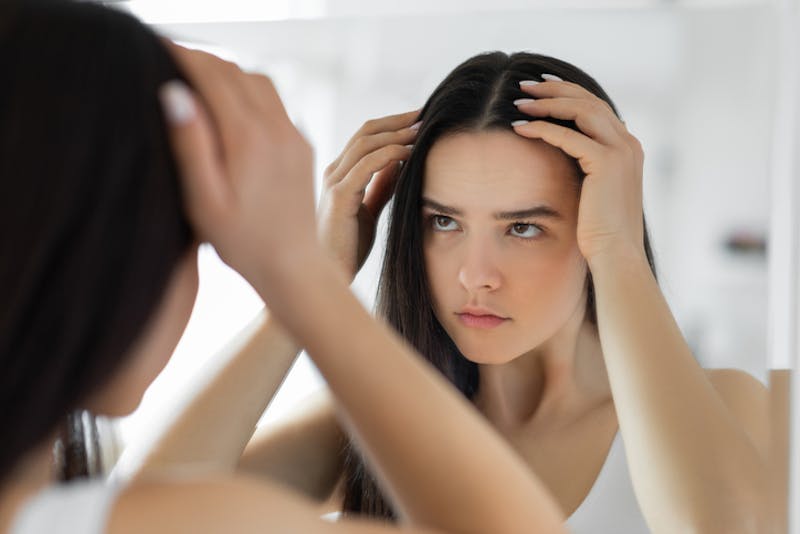
Scalp psoriasis is one of the most common places psoriasis shows up, affecting more than half of people with the condition at some point. It's also one of the most frequently misdiagnosed, because at a glance, it can look a lot like stubborn dandruff or a dry scalp. The problem is that treating it like dandruff usually doesn't work, and can leave patients stuck in a frustrating cycle of over-the-counter products that never quite fix it.
Dandruff typically causes fine, white or yellow flakes and a mildly itchy, oily scalp. Scalp psoriasis looks and behaves differently. It causes thicker, silvery-white scaly patches that can extend beyond the hairline onto the forehead, back of the neck, or behind the ears. The patches are often raised, more clearly defined, and can be itchy enough to disrupt sleep or cause noticeable discomfort, not just mild flakiness.
If you've tried anti-dandruff shampoo for weeks with no real improvement, that's usually a sign it's worth getting evaluated rather than switching to yet another over-the-counter product.
This is one of the most common questions we get, and the answer is yes, though it's usually not the psoriasis itself doing direct damage to hair follicles. Hair loss with scalp psoriasis typically comes from:
The encouraging part is that hair loss from scalp psoriasis is usually reversible once the underlying inflammation is controlled and patients stop picking at the scale. This is exactly why treating the scalp condition and addressing hair thinning often need to go hand in hand rather than being treated as two separate problems.
Treatment approach depends on severity and how much of the scalp is involved:
For patients dealing with both scalp psoriasis and noticeable hair thinning, it's worth having a conversation that covers both issues rather than treating them in separate appointments with separate providers. A coordinated approach, where the scalp condition is brought under control and hair regrowth is supported at the same time, tends to produce better outcomes than addressing one and ignoring the other.
If you're dealing with scalp irritation, flaking, or hair thinning, schedule an evaluation with an APDerm dermatologist to find out what's really going on.
Your skin health matters, so don’t delay. Our clinicians look forward to treating you and your family at one of our local New England practices.
Find Your Nearest APDerm Center