
Your Family Deserves the Best Care Book an Appointment
Your skin health matters, so don’t delay. Our clinicians look forward to treating you and your family at one of our local New England practices.
Find Your Nearest APDerm Center
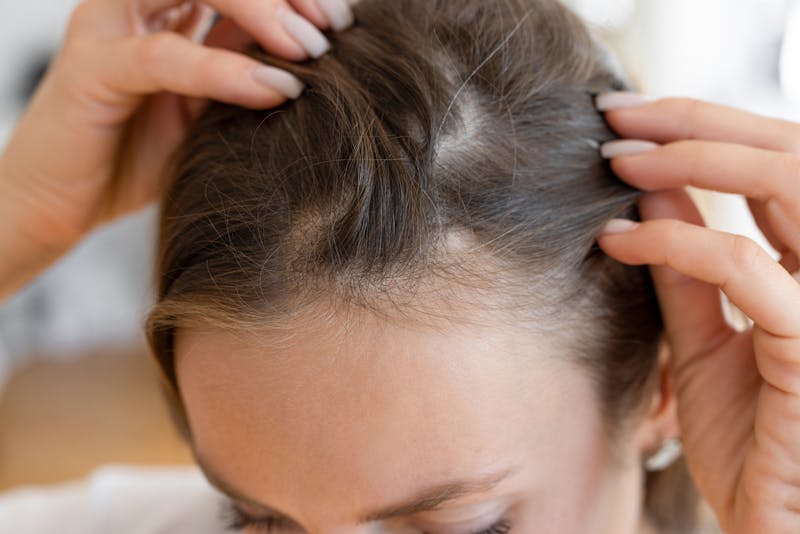
August is Hair Loss Awareness Month, and every year it prompts more conversations with our patients about something a lot of women deal with quietly, often for far too long before seeking help. Hair loss in women is common, affecting roughly one in three women at some point, but it's still treated as more taboo than male hair loss, which means many women wait longer to ask for help and have fewer options by the time they do.
In honor of the month, AP Derm pulled together the questions we hear most often from patients and put together honest, direct answers.
Yes. Most people shed 50 to 100 hairs a day as part of the normal growth cycle. It becomes a concern when you notice more shedding than usual, thinning at the part line, or visible scalp showing through your hair.
This is the most common pattern in female hair loss. Unlike men, women rarely see a receding hairline. Instead, thinning typically starts as a widening part and diffuse volume loss across the top of the scalp.
Yes. This is called telogen effluvium, and it's one of the most common causes of sudden shedding in women. It usually shows up two to three months after a stressful event, illness, or major life change, which is why patients are often confused about the timing. The good news is that it's typically temporary once the trigger resolves.
It can be. Hormonal shifts during perimenopause and menopause can trigger or accelerate thinning, particularly if there's already a genetic predisposition to female pattern hair loss. This is one of the more common reasons women seek treatment in their 40s and 50s.
Possibly. Thyroid conditions, both underactive and overactive, are a well-established cause of diffuse hair thinning. This is one of the reasons bloodwork is often part of a proper hair loss evaluation.
Yes, and it's one of the most overlooked causes. Iron deficiency, even without full-blown anemia, can contribute to thinning. It's also one of the more correctable causes once identified through bloodwork.
Shedding refers to hair falling out, which is normal in limited amounts. Hair loss refers to hair not growing back, which is what leads to visible thinning over time. Telogen effluvium is primarily a shedding issue, while female pattern hair loss involves both increased shedding and reduced regrowth.
There isn't one universal answer, since it depends on the cause. Topical or oral minoxidil is the most well-studied starting point. PRP therapy is increasingly used for those wanting a more active procedural approach. For hormonally driven thinning, prescription options like spironolactone may be added.
Yes, for many women it's effective, particularly when started early and used consistently. It won't work for everyone, and results reverse if you stop using it, but it remains one of the most evidence-backed non-surgical options available.
PRP involves drawing a small amount of your own blood, concentrating the platelets, and injecting them into the scalp to stimulate follicles. Most patients describe mild discomfort during the injections, similar to a series of small pinches, and no downtime afterward. Some of our locations also offer Painless PRP options for patients who want a more comfortable experience.
Most non-surgical treatments take three to six months before you notice a real difference, since hair growth cycles are naturally slow. Patients often get discouraged around month two, right before results typically start showing.
Often, yes, if caught early. This is called traction alopecia, and if the follicle hasn't been permanently damaged, hair typically regrows once tension is removed. Long-standing cases with visible scarring are less likely to fully reverse.
If you're noticing more shedding than usual for more than a few months, visible widening at the part, or thinning that's affecting your confidence, it's worth getting evaluated. Getting an accurate diagnosis early gives you more effective options than waiting until thinning is significant.
This Hair Loss Awareness Month, schedule a consultation to get an accurate diagnosis and a treatment plan built around your specific cause.

Your skin health matters, so don’t delay. Our clinicians look forward to treating you and your family at one of our local New England practices.
Find Your Nearest APDerm Center