
Your Family Deserves the Best Care Book an Appointment
Your skin health matters, so don’t delay. Our clinicians look forward to treating you and your family at one of our local New England practices.
Find Your Nearest APDerm Center
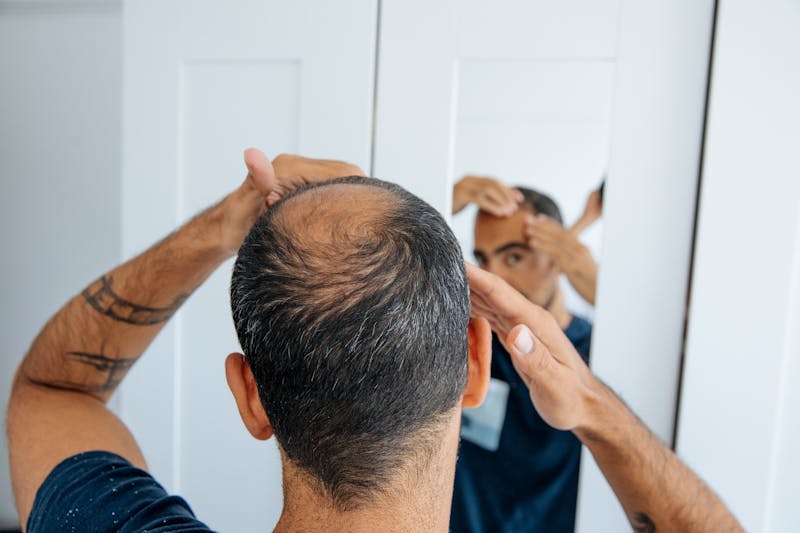
Hair Loss Awareness Month gives us a good reason to revisit the questions we hear most often from patients, especially the ones men tend to sit on for years before finally asking. Male hair loss is common enough that a lot of men assume it's simply something to live with, but there's a wider range of effective treatment available today than most people realize.
Here are the questions we get asked most, answered directly.
It varies, but many men notice early signs in their late 20s to early 30s. By age 35, roughly two-thirds of men experience some degree of hair loss, and that number continues climbing with age.
Yes, in the vast majority of cases. Male pattern baldness, or androgenetic alopecia, is driven by genetics and a hormone byproduct called DHT that gradually shrinks hair follicles over time.
Both. This is a common myth. While one specific gene variant is inherited from the mother's side, overall genetic risk for pattern baldness comes from multiple genes on both sides of the family.
Yes, transplanted follicles are typically resistant to the hormone that causes pattern baldness, which is why results are considered permanent. However, surrounding native hair can continue to thin over time if not treated with medication, which is why many patients combine a transplant with ongoing medical therapy.
FUE removes individual follicles one at a time and leaves minimal, scattered scarring. FUT removes a strip of scalp tissue and can yield more grafts in one session but leaves a linear scar. FUE has become the more commonly requested option for most patients.
This depends entirely on the extent of your hair loss and the results you're hoping to achieve, which is why graft count isn't something that can be estimated without an in-person evaluation.
When performed well, yes. Modern techniques place individual follicles in the natural direction and pattern of hair growth, which is what allows results to look undetectable rather than artificial.
Transplanted hair typically sheds within the first few weeks, which surprises a lot of patients, before regrowing over the following months. Most patients see meaningful results by six months, with full results visible around the one year mark.
Not necessarily, but candidacy depends on having enough healthy donor hair, usually on the back or sides of the scalp, to transplant into thinning areas. This is something best assessed in person rather than estimated from a description.
At AP Derm, the earlier you're evaluated, the more treatment options are typically available, including whether medication alone might be enough. Waiting tends to narrow your choices down the road rather than keep them open.
This Hair Loss Awareness Month, schedule a consultation to find out whether medical treatment, a transplant, or a combination is the right fit for you.

Your skin health matters, so don’t delay. Our clinicians look forward to treating you and your family at one of our local New England practices.
Find Your Nearest APDerm Center