
Your Family Deserves the Best Care Book an Appointment
Your skin health matters, so don’t delay. Our clinicians look forward to treating you and your family at one of our local New England practices.
Find Your Nearest APDerm Center
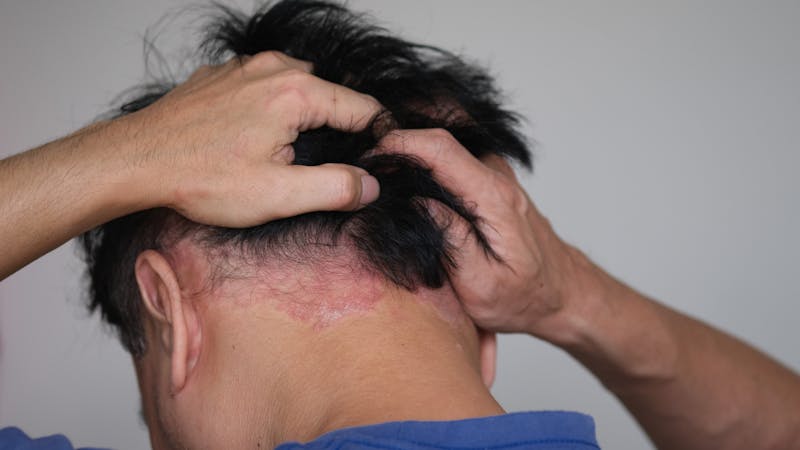
Psoriasis affects an estimated 7.5 million Americans, but it's still one of the most misunderstood skin conditions we see in practice. Patients often come in unsure whether what they're dealing with is psoriasis, eczema, or just dry skin, and that confusion can delay proper treatment. Here's what our dermatologists want you to know.
Psoriasis typically appears as raised, red patches covered with a silvery white buildup of dead skin cells, called plaques. These most commonly show up on the elbows, knees, scalp, and lower back, though psoriasis can appear anywhere on the body, including the nails and skin folds. The patches can be itchy, sore, or crack and bleed in more severe cases.
No. Psoriasis is an autoimmune condition, not an infection. It happens when the immune system mistakenly speeds up skin cell production, causing cells to build up on the surface faster than the body can shed them. You cannot catch it from someone or spread it to someone else through contact.
Psoriasis has a genetic component, but flares are often triggered by specific factors, including:
Identifying your personal triggers is one of the most useful things a dermatologist can help you track over time.
There isn't a cure yet, but psoriasis is highly manageable. Most patients can achieve clear or nearly clear skin with the right combination of treatment, and ongoing research continues to expand what's available, especially in biologic therapy.
Diagnosis usually starts with a physical exam, since psoriasis has a distinct appearance to a trained dermatologist. In some cases, a small skin biopsy is used to confirm the diagnosis and rule out other conditions like eczema or fungal infections.
Treatment depends on severity and location, and often includes a combination of approaches:
Because psoriasis can also increase risk for conditions like psoriatic arthritis and cardiovascular disease, ongoing dermatologic care matters even when skin symptoms are mild.
If you're dealing with persistent red, scaly patches that aren't improving with over-the-counter moisturizers, or if you're managing joint pain alongside skin symptoms, it's worth getting evaluated. Early, consistent treatment tends to produce better long-term outcomes than waiting until symptoms become severe.

Your skin health matters, so don’t delay. Our clinicians look forward to treating you and your family at one of our local New England practices.
Find Your Nearest APDerm Center